
Smucker Alleges Copycat Crustless Sandwich Design and Packaging
On October 13, 2025, the J.M. Smucker Company (“Smucker”) filed a federal lawsuit in the U.S. District Court for the Northern District of Ohio against Trader Joe’s, claiming the grocery chain’s frozen peanut butter and jelly sandwiches are illegal copycats of Smucker’s famous Uncrustables®. Smucker alleges that Trader Joe’s “Crustless Peanut Butter & Strawberry Jam Sandwiches” copy the distinctive look and branding of Uncrustables. In particular, Smucker’s Complaint (link here: link ) highlights that Trader Joe’s sandwiches are round and crustless with the same “pie-like” crimped edges as Uncrustables. The complaint describes Trader Joe’s product as “an obvious attempt to trade off of the fame and recognition” of the Uncrustables brand. According to Smucker, the nearly identical design and packaging could confuse consumers into thinking Trader Joe’s sandwiches are made by or affiliated with Smucker.
Smucker’s Uncrustables®

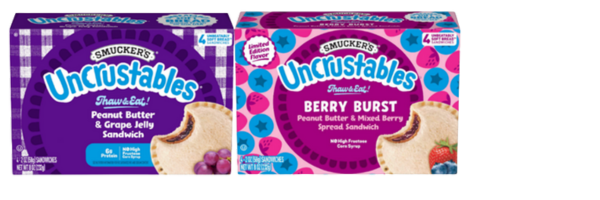
Trader Joe’s Crustless Peanut Butter & Strawberry Jam Sandwiches

Uncrustables have become a massive business for Smucker. The Ohio-based company disclosed in the lawsuit that it now sells approximately 1.5 billion Uncrustables sandwiches per year and has invested over $1 billion in developing and marketing the brand over two decades. Given this success, Smucker considers the round, crimp-edged sandwich design and its blue packaging elements to be valuable intellectual property. In fact, Smucker has obtained federal trademark registrations covering the sandwich’s unique shape (a “round pie-like shape with distinct peripheral undulated crimping”) as well as the bitten-sandwich image used on its packaging.
Trade Dress Legal Issues: Distinctiveness vs. Functionality
The dispute raises important questions about trade dress protection for food products. Trade dress refers to the distinctive visual appearance of a product or its packaging that signifies the product’s source. Under U.S. trademark law (the Lanham Act, 15 U.S.C. §§ 1051 et seq.), trade dress can be protected if it is distinctive (i.e. consumers associate the design with a particular source) and non-functional. Smucker claims that the Uncrustables design has acquired this distinctiveness – known in trademark law as “secondary meaning” – due to the sandwich’s long-term popularity and extensive promotion. The company argues that the round, crimped-edge look and blue color scheme of Uncrustables are now closely identified with Smucker in the minds of consumers, beyond any mere utilitarian purpose.
However, Trader Joe’s is expected to challenge those assertions. A key issue will be whether the shared features are purely functional or serve as brand identifiers. Trader Joe’s could argue that the crimped, crustless round shape is functional – it seals the sandwich to keep filling inside and eliminates messy crusts – and thus cannot be monopolized by one company as a trademark. If a design is deemed functional, it is not legally protectable as trade dress, regardless of consumer recognition. Notably, Smucker itself once secured patents in 1999 for its “sealed, crustless sandwich” innovation. The existence of those early patents suggests the crimped-edge design had practical advantages, a point that may bolster Trader Joe’s functionality defense. Trader Joe’s might also highlight small differences (for example, its sandwich reportedly has a slightly more square shape) to argue that its product is not a slavish copy of Uncrustables’ design.
Another legal question is whether the Uncrustables trade dress was distinctive before Trader Joe’s entered the market. Because product design trade dress cannot be inherently distinctive, Smucker must prove that consumers recognize the round, crustless PB&J and its blue packaging as uniquely Smucker’s – a burden it will try to meet with evidence of its large sales and marketing investment.
Smucker’s lawsuit asserts multiple causes of action under the Lanham Act and related laws, including trademark and trade dress infringement, trademark dilution, false designation of origin, unfair competition, and deceptive trade practices. All of these claims hinge on showing that Trader Joe’s look-alike sandwiches are confusing consumers and diluting the Uncrustables brand’s distinct identity.
What is at Stake?
Smucker is asking the court for an injunction to stop Trader Joe’s from selling the crustless PB&J product and to force a recall or destruction of all existing Trader Joe’s inventory and packaging that mimics Uncrustables. Smucker also wants to recover Trader Joe’s profits from the sandwich, along with damages and attorneys’ fees. Essentially, if Smucker prevails, Trader Joe’s could be required to repackage or pull its product from shelves, an expensive outcome for the grocery chain.
The outcome of this lawsuit will be closely watched in the food and retail industry. If Smucker can prove its Uncrustables design is a distinctive, non-functional mark, it could reinforce the ability of companies to protect the appearance of even simple food products. On the other hand, if Trader Joe’s shows that the round, crimped sandwich shape is functional or not uniquely associated with Smucker, the case could limit how far trade dress claims can go for familiar grocery staples.
For more information or to seek counsel from our Intellectual Property group, please reach out to request a consultation or call us at 216-696-1422.
_____
This information is provided for general informational purposes only and should not be construed as legal advice. Readers should consult with qualified legal counsel regarding their specific circumstances before taking any action based on the information presented.
